Sunday, December 28, 2014

Holy Innocents

A couple of nights ago I dreamed I was entrusted with a beautiful two year old African American child to care for and love . . . and I lost her. I searched and searched, all the while berating myself for being so careless. You don't have to be Freud to figure THAT one out.

It's been a weird Christmas. We spent three and a half months trying to fit Elizabeth into treatment options that didn't quite fit. She did okay for a while but struggled with the living with another family and being sort of part of the family—she was in their Christmas card picture—but not quite. They asked for time off over Thanksgiving and she went to a respite home for the weekend. She crawled out the window and ran away, seeking shelter in a Japanese restaurant, whose staff called the police. Things deteriorated from there and soon she was back in the emergency room, then the hospital, a new one this time. 

Christmas day, Claire and I went over to visit. Five families shared a small room, observed by a nursing assistant in a Santa hat. We opened presents, passed around contraband food, and debated what the kids could keep and what would have to go home. Hang on, we kept telling her. Stay in control. That's your way out. But yesterday she got into a fight with another kid, whose parents pressed charges.

I drove over to talk to the officer. He was reasonable and immediately got it. "Why's she here?" he asked me. "For aggression," I responded. "Did the hospital know that?" he asked, puzzled. They did. "So why were they not monitoring her more closely?" I don't know. This is the third time charges have been brought against her, all in a hospital setting, all for exhibiting symptoms of her mental illness. He refused to arrest her, an act of mercy, a moment of grace, there within an insane system.

This hospital will most likely kick her out this week. They are a for-profit hospital and there is no money to be made off of Elizabeth. Realistically, I've given up hope for treatment now. My goal is to keep her alive and out of jail until . . . I don't know until what. Perhaps until I can create a place for her to be that can help her. I'm not sure people really talk about treatment for severely mentally ill people outside of hospitals right now. There are actually fewer treatment options than there were a few years ago. Since Sandy Hook, North Carolina has cut funds for mental health two years in a row. We've also refused Medicaid expansion, which could provide mental health access to thousands more. Once again legislators tried to close Wright School, the only ray of hope for NC children with mental illness. It's a bad time to be a child with mental illness in North Carolina. 

It's actually a tough time to be a child anywhere. This month Taliban militants in Pakistan massacred 132 children. In April of this year, 273 school girls were kidnapped from the Chibok Government Secondary School by Boko Haram Terrorists in Nigeria. #Bringbackourgirls we cried. But they didn't and we lost interest. Twelve year old Tamir Rice was shot and killed holding a toy gun. #Blacklivesmatter we cried. Others protested that #alllivesmatter, totally missing the point that, as George Orwell pointed out, that while all are equal, some are more equal than others. Far too many children are killed yearly by guns, often in schools that should be places of learning and safety, while second amendment advocates piously protest about any attempt to keep children safe from guns. Children languish in foster homes, waiting for forever homes, so many that the state of North Carolina maintains a catalog for you to browse.

When JRA moved into a new building in June, we were at 34 children. We accepted an upper limit of 60 kids to appease our neighbors, the ones who thought the sound of children playing would lower their property value. Sixty kids seemed like an unattainable goal. 2014 ends with 52 children at JRA, with five more entering in January. The kids that come to us in January are usually in bad shape with desperate parents. They've been battered by their school systems, systems filled with mostly good people who have seen their resources cut. They're still expected to work miracles with difficult kids and they aren't allowed to say they can't even when they know they can't. Good teachers are leaving in droves and special education classes often have teachers with little understanding of the kids they serve. And so parents sit in my office and cry as they watch their once cheerful kid deteriorate and beg to stay home from kindergarten.

There will be those who want to know where my outrage is for those babies who are aborted each year. I hate abortion; I want it to stop. But I do not understand the passion for the unborn when those same people care little for the born. I don't know how to stop abortion, especially when we make it so hard for poor parents and parents of those with special needs to care for their children. My motto is that of Mother Jones: Pray for the dead and fight like hell for the living. It's all I know how to do.

One song on my playlist year round is Trans-Siberian Orchestra's Carol of the Bells. I sang this carol in high school chorus, and I know how it should be sung, lightly and joyfully: "Gaily they ring, while people sing, songs of good cheer, Christmas is here!" But this rendition is filled with a rage that is jarring and harsh. I understand this rage. Merry Christmas dammit.

Within the Christian story of the birth of Jesus is a part we don't include in the Christmas pageants. Matthew tells the story of Herod killing all baby boys in the vicinity of Bethlehem, hoping to exterminate the newborn king. While this is not mentioned in any other historical document, some speculate that the death of several dozen babies was not a serious enough thing to even be mentioned. Murdered children stricken from history by their insignificance. Kind of like the mentally ill.

Today is the feast day of the murdered babies of Bethlehem. Perhaps we could honor their memories by making the world a little kinder and easier for the children here now. Perhaps we can think a bit less of power and comfort and hold not just our own children close, but also the children who have it the hardest. Perhaps you could be a foster parent or a mentor to a child without a stable home situation. Perhaps you could give money to my school or the Augustine Project, which teaches low income children to read. You could write a letter to your legislator, asking them to learn about Wright School and keep it in next year's budget. While you are at it, remind them that kids matter more than money. Spread the word and send money to Josh's Hope, which helps mentally ill young people transition to adulthood. Get involved with Moms Rising or Moms Demand Action for Gun Sense in America. There are so many organizations, created and run by people who know it's up to us.

I am, by nature, an optimistic person, even at my angriest. We are the hands that can make things happen. Let's get with it.




Monday, July 28, 2014

Elizabeth's Law

It's hard to believe it finally happened today. So much has gone wrong that her team has started calling it Elizabeth's law. She entered Central Regional Hospital Labor Day weekend, 2013, for what I assumed was a three to four week stay. She was finally discharged today, July 28, 2014.

The problem, I came to see, is that there wasn't an Elizabeth shaped hole, anywhere. She has multiple diagnoses, but what matters in the end is that she has a developmental disability and mental illness. You really aren't allowed to have both, but of course, we've never followed the rules in this family. When it came time to discharge her, way back in October, it became apparent there was no place for her to go to school. CHCCS doesn't have a program for the mentally ill and we were told we had to put a homebound provision in her IEP in case there were any problems in school. We all knew there would be problems at school. Homebound consists of two hours a week with a teacher. The rest of the time she's mine. Which means I couldn't work and besides, that's hardly an education. Try sending YOUR kid to school two hours a week and see how fast you get reported for truancy.

So we started looking around. We'd sit in a meeting while her Developmental Disability care coordinator, Mr. W, and her mental illness care coordinator, Ms. S, and her CRH social worker, Ms. P, talked options. I was there but I wasn't much help because I cried a lot. Mr. W would throw out what sounded like a good plan, but Ms. S had to shake her head no. "Her IQ's too low for that program." We'd sit in silence while they scrolled down on their laptops. "How about this one?" Ms. S would ask. Mr. W would shake HIS head. "They don't take kids with mental illness." Ms. P ventured a suggestion. They both shook their heads. "Cardinal Innovations won't contract with that place." After one particularly frustrating meeting, I said, "So what I'm hearing is she can't come home, she can't stay here, and she can't go anywhere else. Is that correct?" After a short silence, all three agreed: "That seems to be the case."

The good thing about Central Regional is that it's the one place in the state that can't kick her out. It's not meant for eleven month stays, but they'll do it if they have to. Our two psychiatrists were awesome, but what really mattered were her psychologist and her social worker. Dr. S graphed data, looking for patterns, causations, results. He also supervised her therapist intern who made great progress with Elizabeth. Her social worker spent countless hours talking to me, looking for untapped resources, and doing cute craft activities with Elizabeth. None of them ever treated me like I was stupid or a pain. No one ever talked down to me. It's an unusual feeling.

And then in January, we found an option that worked for everyone. An agency called Caring Hands had alternative family living homes, a place she can stay until she is 21. And the home they identified was the one thing we hadn't tried: an extroverted African-American couple with a one year old grandchild living with them. Elizabeth is at her best around small children. We met them and we all fell in love with them. The only hold-up was that they were not yet licensed, but that should only take a month or so, everyone assumed.

Elizabeth's law. Four months later, they were still working on repairs to their very nice house, sneaky problems within the septic tank and well. Although it was costing the state $1200 a day for Elizabeth's hospital care, no one could front the family the money it took to do the repairs. They finally raised it, only to spend it on someone who did substandard work, causing them to once again fail the inspection.

The corollary to Elizabeth's law is that when things go wrong, someone amazing will step forward. In this case it was the contractor working on my school, who went to the home and supervised the work so that it was done correctly, without being paid for it. And this time it was. The fire and sanitation inspection was scheduled for a week out, then another permit, and then to the state for approval.

All that would have been fine, except if she were not out of the hospital by July 30, she lost the funding that made this possible, no exceptions. We all knew that date was there, but it seemed so far away. And then it wasn't any longer. No one was willing to leave it to the 30th, because Elizabeth's law meant that there would be an earthquake or something like that that would prevent her from leaving. So her discharge date was set for July 28.

I should have been very stressed, but I wasn't. My care coordinators and the Caring Hands people were stressed enough for all of us. Adding to the stress was the fact that the NC legislature has access to her medical files and get regular reports on what was happening with her from no less than the CEO of Cardinal Innovations (like the Blue Cross of Medicaid). No one wanted to be the one that messed this up, plus, they all had come to truly care about her. When it because apparent that the first home wasn't going to be licensed in time, Caring Hands identified a backup plan, with an interim foster home until the other was licensed.

Transitions are not Elizabeth's strong suit, and she couldn't see past the time she was with the second home. She wanted to be with the first one and totally shut down when we met the C's, the interim family. They are an older African-American couple with grandchildren and another child already in their home. When we met, Elizabeth wouldn't even look at them. Desperately trying to make conversation, I asked Mr. C if they were Duke people or Carolina people. He laughed and admitted to liking UNC. Elizabeth mumbled, "Holden," a family friend and familiar UNC name. Mr. C looked at her for a moment and then began to talk about what a fine person Holden Thorp was, how Holden had played piano at his brother's retirement party the last year. Elizabeth's head slowly raised, and although she still wasn't happy about the temporary placement, at least we had ascertained that our people knew each other, an important consideration for a southerner.

I had her for a pass on Saturday. We met Claire for lunch and in the middle of the meal Holden called her to tell her how much he liked this family. This meant she was willing to go, as long as we promised her she'd be with the L's soon. She was scared to go to church with them, probably because she was afraid people would think she was like their other child, who had autism and was in a wheelchair. We went thrift store shopping for baby clothes for her doll, which was allowed to go back to the hospital with her this last time. We had tearful times; she wanted to make sure I was still her mom and Claire was still her sister, and that she'd come home someday. I said yes to all three and only one was a lie.

The truth is, she can't live at home with me. Her anxiety is too high and she becomes violent when she does not feel safe. There have been too many injuries, too many police calls, too many long waits in the ER. Central Regional is the only hospital in the state that will still take her and when they don't have open beds, we're up a creek. This foster home has advanced training in all her needs. They are constantly on the go, something she craves. She can be part of a very large extended family, all the same color as she is, and that's important to her. Mr. L has 14 siblings and every single one of them graduated from college. They value the things I do and asked if they could take her to Moral Mondays. Mrs. L is a hairdresser, a real bonus. She has her own room and the house has a security system which helps her anxiety.

The school situation is up in the air. For the summer she'll go to a day treatment program. We'll figure out the school year when it's closer. It pains me to say this, but I'm glad she'll be 16 this year so she can legally quit. There is just no school for her; she cannot function socially with kids her own age. Put her around toddlers and she does just fine. I tried her at JRA; I can help everyone else's kid but I can't teach my own. The most I can hope for is a kind of karma, that the care and help I give to other kids will come back to her through someone else.

It's hard to admit that I am not a success at parenting her. This is not a plea for reassurance, but a simple statement of fact. For one thing, it takes more than one parent to rear this child; I'm thinking five might be just right. Also, she is torn with loving me so much and wanting a different kind of family. The best parenting I can offer right now is to love her unconditionally and let her go. There was a time I thought love could conquer anything, but I was wrong. She has spent three weekends at the L's and it went well. She felt safe and connected. I am still her legal guardian and I am still her mom. She'll come home sometime and we'll still see her. We are just making the family bigger.

She just called me to tell me goodnight. The C's had taken her to their church revival, so she was able to get the scariest part behind her. Mrs. C said she really got into the music, and Elizabeth said it was fun. They had ribs for dinner and their one year old grandchild was staying with them too. Bedtimes are always hard, but it she can get past that, we should be okay. Day treatment starts tomorrow, but not until 1:30.

And I'm okay. Sorta.


Tuesday, January 7, 2014

a really long Facebook status

When you wish you could pick up the phone and talk to someone but most of your friends have no clue what you are talking about and a few know all too well because they live it too. And then you realize you have nothing to say and no words to say it in and so you don't call anyone but go home and get out of the car into the polar vortex air, wondering why there is ice on your face and you feel so drained.

When you try to concentrate in a meeting about your child's future but she is screaming your name so loudly the whole two hours a few rooms away that you can't hold it together. And when people in the meeting don't look at you anymore because they've tried so hard and it hasn't helped and they feel inadequate and a little angry. And when everyone at the meeting realizes she is not going anywhere anytime soon because she has been in an acute state for five months now and besides there is absolutely nowhere to send her, nowhere, not here, not someplace else in North Carolina, not out of state, except this state hospital, because no place that wants to make money is going to take her. And when the Medicaid care coordinator has nothing to offer but his prayers even though he's really not allowed to say that but does anyhow because he's a nice guy.

When the doctor you loved, the one that spent hours talking to you, asking questions and thinking about options, that doctor gets transferred to another unit and you get a new doctor who is a nice guy but he talks at you not to you and never asks one question except will you give your consent to this new medication. And you're not allowed in the unit and they rotate nurses and so you've never seen her room and you don't know any of the nursing staff that work with your kid and the only thing you know is that she cries for them when she's with you on a pass from the hospital.

When you see her holding a friend's three-year-old in church, looking like a normal fifteen year old, and you have a moment of feeling like everyone else. And then she almost breaks the psych ward window and you remember other people's kids don't do this. And they don't have door jambs torn out of the wall and they can have company who don't already know their story.

When you hold your baby's hand and see initials carved into her arm, marring the smooth brown skin you've always loved. And when her hair is wild and unkempt and she can't sit still long enough for anyone to do it and there's no point in it anyhow because it will get messed up during the next restraint but you still remember the soft powdery scent of it when she burrowed into you as a baby. And when she says mean things to you and to other people that you know aren't in her but yet they are because she says them. And you find it hard to believe that this is the same kid who is a rock star to the little kids in church and who buys them presents with her own money just because she loves them so much, who has such depths of kindness and compassion inside her and you wonder where that goes during these times.

When you read the news about a teenager shot by the police because "they didn't have time for this" and you realize that you've called the police to your house dozens of times and this is how your child's story could end too and that there are people who think this would be the best solution because she is too expensive and too hard and there's nowhere for her to be, to exist, much less get better. And you hold like a talisman the picture of her swimming with dolphins that was taken two weeks before this hospitalization and know that is her just as much if not more than the girl the meeting is about. And knowing that doesn't help.

When you are so grateful to have a job you love to go to each day, and you hope you can save some other mama's baby because you sure as hell can't save your own. And when you sit holding a child together after he just hit you because, even though he's really smart, 9 take away 2 is just more than he can handle, but you keep showing him and suddenly he gets it and shouts, "It's 7! It's 7!" and you know that a thousand or maybe ten thousand more moments like that might allow him to not spend years in a state mental hospital and so you do it again and again because it's where redemption lies and you hope maybe someone else will do it for your kid.

You know, that.


Saturday, October 26, 2013

the last Caroline bowl

I first met Caroline when she was a junior tutor in my high school Title I reading class. She was lovely and sweet, but not a student who stayed with me after I left the job. We reconnected several years later when I dated her stepbrother. One summer when I was headed to France to try to master the language, she called and asked if she could tag along. We both enrolled at the University of Grenoble and became fast friends. We spent that summer in our little Grenoble flat, eating avocados and flan, and fruit de mer pizza at restaurants.

She was a soul mate friend, the type you find far too seldom, the kind that can finish your sentence or hear the thought behind the words that don't match. It didn't matter that I was twelve years older. We each believed the other was wonderful and could do anything. We published a newsletter for tutors together, learning to use a computer for the first time. She supported me when I decided to have Claire, going with me to doctors' appointments. She was our first visitor in the hospital, and Claire bears her middle name. I encouraged her when she wanted to open her own restaurant. She took my side when her brother and I broke up. I approved when she spent her whole paycheck on an expensive piece of art. She could fix anything, cook anything, wear anything. She and I and our friend Liz would meet at Breadmen's over French toast and tea, talking for hours. The three of us were in a book group together, one that focused on books written by women and which always included chocolate and wine. She insisted on choosing the wine because she knew I'd drink anything. When I was overwhelmed with housework, I'd channel Caroline and somehow knew where to begin, something I still do to this day.

She married, and she and her husband moved to San Antonio so he could go to dental school. I took the girls on a road trip to visit, a plan everyone thought was crazy except her. She took us to eat real Mexican food and taught five-year-old Claire how to make cream cheese icing. When A. finished school, they moved to Asheville. I was thrilled; Asheville was close.

They hadn't been there long when I got a late-night phone call. "A. doesn't know I'm calling," she whispered. "I don't want to worry him. But something's wrong with me." She was scheduled to see a specialist that week, based on some tests that weren't quite right. "And you're worried about your poor motherless children, aren't you?" I said. "Yes!" she said. "I'm more worried about them than I am for myself."

She called me after the visit with the specialist. "His face was gray," she said. "He had trouble telling me. And A. Oh, Linda, I could hardly bear it for him." 

I started going up once or twice a month. The treatment was brutal. I arranged a mail rota with mutual friends, hoping she'd get something fun every day. One friend sent drawings from his child. Another sent yarn so she could knit. I sent favorite mysteries and postcards of Paris. We'd talked about going again as old ladies, and I was going to hold her to it. 

She vacillated between stoic realism and passionate hope. I saw my role as supporting her in whichever mood she was in. "Of course you're going to beat this," I'd say on Monday. By Wednesday we were talking about wills or funeral plans. It was on a hopeful day that I thought up the pottery hook. "Every time I visit, I'm going to buy a piece of pottery. First bowls, then plates, then mugs. You have to stick around long enough for me to feed twelve." The rules were that they didn't have to match, just be local and blue.

There is no shortage of potters in western North Carolina, and on every visit I found one on my way home and added to my collection of bowls. The girls and I began referring to them as the Caroline bowls. Two bowls, then four . . . soup and cereal and salad and mac and cheese, always in the Caroline bowls, beautiful blue, unique works of art. So much of our time together was centered around food, and it seemed right to hold her close in this way.

The next visit was in the hospital. I held her hand and listened to her shallow, pain-filled breaths, staying by her side so her mother and husband could run errands, fill prescriptions, and arrange to take her home. I watched the IV dripping into her skeletal arm, now the only way she could eat.

After I left, I stopped in Black Mountain for dinner and a bowl. I found a side-street pottery shop, and although it was pouring rain, I WAS going to buy my damn bowl. I picked up one that seemed to match the weather, and as the woman wrapped it to take home, she casually asked if it were a gift. "No," I said. She must have heard something in my voice because she stopped and looked at me with concern. The kindness was more than I could bear and I broke down sobbing. She came around the counter and hugged me, both of us crying, as I poured out my story and my pain. Thunder rolled and lightning flashed and rain beat against the window, until finally the pain was diluted and I was able to speak again. I took my package and drove home, stopping at McDonalds on the way. 

She died the day after her fortieth birthday, as I was sitting with two good friends, drinking wine and reminiscing. When I got home that night, my answering machine light was blinking. I put the girls to bed before I checked it because I knew what it would say. I listened to her sister-in-law's voice, and although I wasn't really hungry, I got the last Caroline bowl out and sat down to eat some soup.


Monday, December 24, 2012

Do not be afraid

Our Christmas Eve tradition is to go to the 5:00 pm service, one that includes a slide show narrative of the Christmas story as told by Luke and enacted by children in our parish. For years it was my pleasure to put this show together, a job I loved because every year I found something new in the story. Tonight I watched with equal joy(plus no stress!) and yet again, something new stood out.

Mary is quietly minding her own business, perhaps mending or peeling vegetables, when suddenly an angel appears. "Do not be afraid," he begins, and then he gives her news which rocks her world. Those words appear again, this time to shepherds watching their flocks by night. Once again, an angel appears, and they are terrified. When the girls were young, one of our favorite Christmas books was This Is the Star, which features an awe-ful angel, filling the page with light and glory and majesty, appearing to shepherds who understandably cower in fear. "Do not be afraid," the angel tells them. After watching this celestial light show, the shepherds leave their sheep to go to Bethlehem.

Do not be afraid. Those words resonate with me because there is so much fear in the air right now. As a small child, my nephew had rules for monsters: they were not allowed in the bathtub or his bed, two places of great vulnerability. Even as more cynical adults, we expect safe places. Yet twice in ten days, a shooting struck where we thought safety lay. Twenty-six children and adults were murdered in classrooms with tiny coats on hooks and crayons in desks and abc's on the wall, leaving a schoolful of survivors who will never feel safe again. And today, firefighters responding to a fire were picked off by a sniper, killing two and severely injuring two more. Firefighters are the ones who come to save us. Without them, life becomes immeasurably more dangerous.

Do not be afraid. Almost a year has gone by since Elizabeth was sent home from her psychiatric residential treatment program by people angry they couldn't fix her. Anxiety is a horrible thing and Elizabeth suffers greatly from it, especially at night. Many times our small house feels too big and unsafe, and we end up in the car driving for hours in the dark until she falls asleep. Many times her social anxiety causes her to strike out at others, saying unkind and hurtful things. I feel worn out and stretched, but there is no margin for error with her and so I must not show my exhaustion and hopelessness. Her anxiety is contagious, causing others to fear her and worry over what she might do next. Even now, almost midnight, she lies in her bed, anxiety and excitement over Christmas tied up together, keeping her awake.

Do not be afraid. Many are without work and struggle to pay their bills. I HAVE work, yet I still struggle. Elizabeth is an expensive child and I juggle where the money goes. I try to triage: trip to the vet for a cat, five separate plumbing problems, a broken window in the girls' room, new tires, shoes that don't hurt, bills unpaid. I find myself paralyzed, unable to decide, until one becomes a crisis and the decision is made for me.

Do not be afraid. As I reread Luke, I'm struck by how Mary and the shepherds respond. They take action, Mary saying yes and the shepherds taking a roadtrip to see for themselves. But first they stop being afraid. That's an important detail because if we take action while we are still afraid, it's a very different action. When we are afraid, we see the world as a dangerous place with people who are trying to take what is ours. We may think we need more guns to protect ourselves against the bad guys. We hoard our money out of fear of not having enough. We worry that people are taking more than their fair share, even if we don't need it. We make our world smaller and, we hope, safer. Paradoxically, the smaller and more heavily armed it becomes, the more unsafe it feels.

One of the healthiest suggestions to come from the Newtown shooting is to do an act of kindness in honor of each victim. I decided to take this task on; doing so has forced me to expand my world, to look outwards instead of circling the wagons. Paying for the car behind me in the drive-through or letting someone go ahead of me in line reminds me that they are people like me, tired and broke and afraid, and not someone to guard against. It's not charity but community, an acknowledgement that we really are all in this together.

Meanwhile others have expanded their world to fit our messy family in. When I could no longer stand it, Deb, Amy, Sadie, Summer, and Sarah invited Elizabeth into their homes for afternoons and days, allowing me to breathe again. Our friend Tom meets with Elizabeth weekly, gently helping her to understand her story and her fears. Several significant and unexpected gifts, one from our Christmas Eve magi, have taken the edge off our financial crises, and once again reminded me that we have enough. The teachers at school take a deep breath and try again to help her succeed.

Tonight I feel peaceful and calm. Claire is home from college and Elizabeth has finally fallen asleep. We spent the evening with friends and Elizabeth's birth family. The stockings are filled and the presents are wrapped. I'm sleepy and grateful for family and love and laughter and good food. I'm thankful for fear-free moments, when I can see clearly and act wisely.

Do not be afraid. It's a choice as well as a call to action.

Friday, September 14, 2012

how Lindsay singlehandedly saved Al Gore's press conference

The Democratic presidential primary in 1992 was confusing and filled with somewhat unknown players. President Bush's poll numbers were extremely high and his reelection seemed to be a certain thing, and the first-string Democrats had no interest in running a losing campaign. I can't even remember whom I voted for in the primary; by the time the North Carolina primary rolls around, there is no mystery about who the candidate will be and our votes don't really count for much except gravy. And Bill Clinton, the candidate who surged ahead, fell behind, explained his affairs on national TV, and finally crossed the finish line with more than enough delegates, looked like a very long shot.

But on a hot July night, my sister Leslie and I sat in her bedroom, she ironing while I planned lessons. The TV was on and it was Clinton's night to speak, to accept the nomination. He sounded like Elvis and he strung simple words together in a mesmerizing way. Nothing wonky about that speech. My lesson plans and phonics cards slipped off my lap as I listened to, no, FELT the cadence of his words: "That's what the New Covenant is all about." I noticed Leslie paying a bit more attention: "But this is America. There is no them. There is only us." Finally both of us were sitting at the end of the bed, transfixed: "We can do it. We can do it. We can do it." We looked at each other. I don't know which one of us said it first, but we both knew what we had to do: "Let's go work for this guy."

Which was how we found ourselves in the newly-rented Democratic State Headquarters in Raleigh in late July with a toilet brush and a broom. Full of enthusiasm, we had presented ourselves ready to change the world and found that it first needed cleaning. It wasn't exactly what we had in mind, but it had to be done and we were certainly qualified for the job, so we dove in. It was a rabbit warren of offices, far too big for a state not expected to be in play, and the party chairmen were walking through, deciding who should be in which office. As they came to the room we were cleaning, Leslie piped up: "Have you thought about having a childcare room?" They looked at her silently. Yikes. "You know, for volunteers who would like to help, but would have to bring their kids?" My voice trailed off as they turned their attention to me. Okay, obviously a bad idea. The silence continued. They looked at each other. "That's brilliant!" one of them finally said. "Let's choose a room."

Which is how we found ourselves sharing the position of State Volunteer Coordinator. Our job was to recruit and assign volunteers to the myriad tasks that had to be done: looking up phone numbers, setting up chairs, running materials to people who needed them, answering phones and questions. One of our first tasks was to set up the Family Values Childcare Room, and it was used, a point we were proud to make when Hillary Clinton toured it. There were nine candidate or candidate's wife visits, along with a few celebrities, but it was the volunteers we met who left us in awe. Sanitation workers in bright orange shirts came in after work, so tired they could hardly stay awake, but determined to help in any way they could. More than one elderly woman sobbed in our office, telling about the illegal abortion their mother or sister or friend had, and their determination to make a procedure no one wants to have legal and safe. College students came in great numbers. There were African-Americans and white people, gay and straight, long haired guys on bikes and men with sunburned arms in pickups. There was no them; there was only us. It was heady stuff.

As the summer moved into fall, the race became more competitive in North Carolina, and things heated up around the office. Lindsay, Leslie's daughter, was three at the time, and Leslie and I both had full-time jobs, but that was no deterrent. I'd work late afternoon until she got there bringing Lindsay. We'd both work until about ten, eating kung pao chicken in large quantities and trying to come up with ridiculous numbers of volunteers for the ever increasing number of tasks. Lindsay moved from desk to desk, occasionally falling asleep under one. Once I looked up to find her showing Ron Brown around the office. Another night Valerie Harper walked in holding her. Around ten, I'd take her home, leaving Leslie to finish up and close down the office. It was a 40 minute drive to Hillsborough; she'd sing Christmas carols to keep me awake, but a couple of times I was so tired I forgot to stop and went all the way to Greensboro.

In September, one of the state chairs came running into our office. Al Gore was having a press conference at the Ronald McDonald House in Durham about the Family Leave Act. One of the families who was part of the press conference had to drop out. Our boss was asked to find another family on very short notice. "Well," he said. "We have one, but it's not a Dan Quayle type of family. It's two sisters raising a child." Send them over, he was told.

Which is how we found ourselves sitting in a 100° room with several other families, waiting on Al Gore to make his appearance. There was a phalanx of bored-looking press types helping to raise the temperature with their sheer numbers. At this point in the campaign, everyone knew there were no surprises with Gore. The jokes about his woodenness are so true that he collects them. On the bus tour we took with him and the Clintons, you never knew what Bill was going to come out with, but you ALWAYS knew what Al Gore was going to say. We stood behind the stage at fairgrounds and courthouses, unseen by the crowds, like a small army of zombies, reciting the speech from memory, complete with his jerky and rehearsed arm movements.

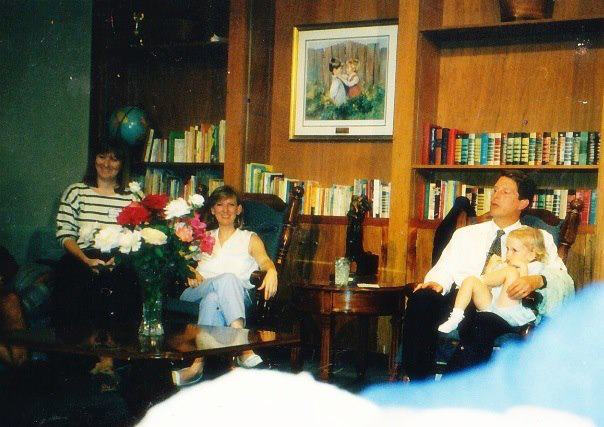
Gore arrived, was introduced, and proceeded to move through the press conference like an automaton. I saw one of his aides close his eyes in exasperation. Another desperately suggested he meet each of the families who were present, so he moved around the room introducing himself to each of us. As our turn came, I leaned down to Lindsay. "Do you know who this is?" I asked. She looked up at him with a wrinkled brow, obviously disappointed. "Yes. It's Al Gore. Where's Bill Clinton?" Gore started laughing and then asked if she'd come sit with him. Lindsay, who has never met a stranger in her life, jumped up and sat on his lap, while Leslie and I silently prayed for her to remember her newly-acquired  and somewhat shaky toilet-training, at least for that day.

And he . . . relaxed. As Lindsay covered him with her blanket and offered to share her pacifier, he patted her arm absently while he waxed eloquent about why we needed the Family Leave Act, about how families with a sick loved one need to be able to care for them without fear of losing their jobs. Four years before, his young son was critically injured when he was hit by a car; he had lived this. This was something he was passionate about, and it showed, finally. Of course, I thought, as I watched him with Lindsay, he's a dad. He knows how to do this stuff. The press no longer looked bored; indeed, it sounded like the machine guns in old war movies as cameras clicked continuously.

The press conference came to to a triumphant end and his aides found us in the crowd. "We owe you one," they said.

Which is how we found ourselves in the front row of Bill Clinton's inauguration, sitting next to Jesse Jackson and the Marine Corps Band and a Blood and a Crip. But that's a story for another time.

Friday, August 10, 2012

out of the nest

Not too long ago, I had a baby, a cute little chubby cheeked thing. At least it FEELS like just a bit ago, and I still have my baby weight to prove it, so it must be true. It's an odd thing though—I dropped her off at college today. She was never a clingy child, but oh, how quickly a mom can become superfluous! Claire's actually going a year early, but the fact that she did all the application stuff herself when I wasn't paying attention lets me know she is probably ready, even if I'm not. During the summer I had numerous panic attacks about whether she was properly prepared for the real world. I finally sat down and made a list and I am feeling better about things. I will not claim that I taught her all these things but I did some and she picked the others up somewhere along the way.

The first thing on my list, an item of cruciality, is her ability to make a white sauce, which means she can cook loads of things. Not only that, but she can make a gluten-free, dairy-free white sauce. She can also make killer chocolate kahlua cream cupcakes, a skill that will make friends and influence people. She is not afraid of quinoa and she knows many uses for coconut oil. Her room is right next to the dorm kitchen and she will put it to good use.

She can do her own laundry and has for years. She can also use a laundromat, something that I've insisted both of my kids learn because there will be a period in their lives when they have to do that, and there is no point standing around looking foolish, jingling quarters and wondering which machine to use and where the detergent goes. Along those same lines, she can pump gas. Although there are times I've doubted it and today is one of them, she can clean a bathroom. She can accessorize with confidence and style; I did not teach her this.

I did read her Dr. Seuss and Winnie the Pooh and Laura Ingalls Wilder and the Chronicles of Narnia and the first Harry Potter. I couldn't read fast enough for her liking after that and she politely relieved me of that duty, but I'm pleased that I got those in because they are all critical to a sane and thoughtful childhood. And she continues to read an amazing range of things, including all of Shakespeare and Stephen King and several online scholarly journals.

Continuing on the Winnie the Pooh theme, she knows how to play Poohsticks, something we did with her friends when they were toddlers. A few years back we were at a youth group picnic, and the frisbees and footballs sat unused, the teens nowhere to be found. When I investigated, I found them playing Poohsticks on the same park bridge they had played on when they were younger. It's a good thing to know how to slow down and watch a stick bob in the stream and this is one of my proudest parenting accomplishments.

She loves Bruce Springsteen and she will almost certainly say that I had nothing to do with that. I don't mind her believing this; she probably doesn't remember the Springsteen cassettes I used to play her on her brightly colored Fisher-Price battery-operated cassette player. Last summer her boyfriend's father took them on a pilgrimage to Asbury Park and she got to see Bob Dylan while she was there. That made me happy. Among the things she chose to take to college were two prints of Bruce in concert that her uncle took years ago.

Contrary to what many want to believe about this younger generation, she, like others her age, knows how to work; in fact, this school year and summer she worked two jobs and plans to work in college. One of her more marketable skills is that she can teach someone to read, which is essential to helping others be successful. She can milk a cow—well, sort of—and feed pigs. I don't know how important that is unless one is a cow or a pig or a farmer, but I'm glad her job skills are so varied. And after her first semester at State, she will be well on her way to being a beekeeper.

She has excellent taste in guys. For that I heave a great sigh of relief; there is a possibility that she won't make the same dumb relationship choices that I did. She doesn't feel the need to change to please her boyfriend, nor does she try to change him. And she has a life apart from him. Those characteristics greatly improve her chances of being happy. She has good friends who have many of her same traits, and so I don't worry about her when she's out.

I'm not sure where she got her strong will, but she has one and she has convictions. Perhaps they aren't the same things I believe, in fact many of them aren't. But she never lacks for an opinion (as many of my Facebook friends will attest), and she can articulate a position and support it with facts. She circulated her first petition in kindergarten, one to convince the teacher to let the girls play football too. I still have it. She became a vegetarian at age seven. At age ten, she and some friends started an organization to feed children in Haiti, one that continues today. Last fall she traveled to meet the children she has helped feed. And she can write and read and speak. I am convinced that it doesn't matter what she majors in; someone with those skills will have her pick of jobs.

While she has no patience for bigotry of any kind, she is tolerant when it matters. This is a good thing because I strongly suspect that her roommate was assigned on a day when the housing office was very bored. "What if we take THIS kid and put her with THAT kid?" Riotous giggles ensued, I know they did. "Make sure you put a video camera in the room and throw in some political material to stir the pot!" It may not always be easy, but I know with certainty that she will be kind, and I'm proud that she didn't do the knee-jerk thing and ask for a roommate change straight away.

While hanging out at the church waiting for me, she read the Bible and knows it well enough that she can quote fake Bible verses and almost fool me. Leviticus is her favorite book, which I find odd, but I think she likes reading the arcane rules. This is not to say that she believes in what it says, but belief is not something I have any control over and I'm always bemused by parents who think they do. I'm just impressed that she actually read it. Too many people who claim to live by it have no idea of what's actually in there.

She knows how to take the bus and can get around Chapel Hill/ Carrboro without a problem. Soon she'll figure out the Raleigh/ Chapel Hill bus system. Public transportation can be scary, but once you've learned to navigate one system, you can extrapolate that to other cities. This opens up New York, London and Paris. She'll be okay where ever she goes.

I sent her to Clapping Hands Farm Camp, one of my best parenting decisions. She learned so much there, among them that NO is a power word and must be honored. She got to progress from an annoying younger camper to a trusted counselor and in the process learned a lot about perspective, childcare, and tick removal. Camp's consistent message is that love is really what it's all about.

She can use commas and she even knows what an Oxford comma is. She is dyslexic, but she has made spellcheck her friend, and so even her texts are correctly spelled and punctuated. She can touch type. Although she has flirted with PCs, she is at heart a Mac person. This is important to me because the two kinds of computers support different kinds of thinking, and I am convinced that while PC people keep the world running, Mac people are the ones that will change it.

Are there things she can't do? Plenty, chief among them driving. But she'll learn if she wants to and in the meantime it saves me a bundle in car insurance. Carrying on a long-standing family tradition, she's not so great at math. She doesn't like donuts or watermelon; this causes me concern. Directionality isn't really her thing. I'm comforted by the fact that the list of things she CAN do is so much longer than the list of things she can't do.

As I tally up marks in the plus and minus columns, I realize this is really about whether she will look back with pleasure on her childhood. Living with a sibling with mental illness is no piece of cake, and it often caused me to be absent or distracted at critical times. I know there are no perfect childhoods; divorce, abuse, abandonment, illness, pain, and death are among the things that others suffer. We aren't so unique, but I still have moments of wanting a do-over.

However, the experience of living with Elizabeth and loving her has added a depth to Claire that might not have been there if it were just the two of us. When a friend argues that we are a post-racial society, Claire looks at me in disbelief that anyone could be so naive when her experience living with a sister of color shows her so clearly this is not true. When Claire's friends struggle with depression, anxiety or eating disorders, she is able to see the person behind the illness, just as we hope Elizabeth's friends will do. She knows a lot about the complexity of authority: we've had good cops and bad ones, and we've had competent and incompetent docs. She's seen people in positions to help hurt her sister and she's seen kindness from someone mopping the floor in a hospital. There is enough pain among those who share our circle that she knows the futility of asking "why us?" She has never had the luxury of seeing the world in black and white. In our world, it's all shades of gray.

When Claire was between the ages of two and five, we sat down every evening when we arrived home and had a cup of tea together and talked over the day. That's when it became apparent that this little person had things to say. When Elizabeth became mobile, our tea time came to an end, one might say a crashing end, but I still cherish the memories of those afternoons. As a teen, those times were replaced by her sitting on the end of my bed telling me about her evening, but now that ritual's time is over too. I need to remember that IT will be replaced with something as well, even if it's not yet apparent what it is.

I'm feeling better now. If she will grade on the curve, perhaps I won't do too poorly, especially if she'll give bonus points for the dolphin ride. And I do deserve some credit for not crying today.